September 28, 2026
10 min read
Lip Blush Before and After in Geneva: Results and Healing Week by Week

You have probably seen lip blush before-and-after photos: pale, slightly blurred lips on one side, rosy, well-defined lips on the other. Those pictures are honest about the destination but say very little about the journey. Lip blushing never looks like its real self on the day of the session: the lips are swollen and the colour is too bright, then they flake, turn pale, and the final shade only shows after several weeks. This guide describes in words, week by week, what you will see in the mirror, from your "before" to the healed result after the touch-up. It complements our lip blush in Geneva page, which presents the treatment, and our main salon's detailed guide, which covers choosing a shade and aftercare in depth.
Lip blush in a few words
Lip blush, sometimes written lipblush and also called blush lips or lip blushing, is semi-permanent makeup for the lips. Using a PMU device with very fine needles, a soft, sheer pigment is placed in the superficial layers of the lip. The goal is not to paint an opaque mouth but to revive your natural colour, redefine the contour and even everything out with a gentle gradient. The effect is like a touch of rosy balm that does not come off when you eat, drink or kiss.
What lip blush can and cannot do
Lip blush can add colour to pale lips, even out a patchy tone, sharpen a blurred contour and visually correct minor asymmetry. Because the line is crisper and the tone more even, lips often look a little fuller. What it cannot do is add real volume or change the structure of your lips, and it is not a medical treatment. If volume is your main goal, discuss it with a medical practitioner; the two can be combined as long as enough time passes between fillers and lip blush.
Before: the lips that change most
Your "before" decides how big the "after" will be. The most common starting points:
- Pale or dull lips that make you look tired first thing in the morning.
- A blurred lip line that has softened over the years.
- Uneven colour, with lighter or darker patches.
- Slight asymmetry between the two lips or the two sides of the Cupid's bow.
- Naturally darker or cool-toned lips that you would like warmer and more even.
- Daily lipstick that needs reapplying after every meal.
On very pale lips the before-and-after gap is the most visible: lips go from blending into the skin to having real presence. On lips that already have colour, the change is mostly in the contour and evenness, subtler but very flattering.
Who is it for, and when should you wait?
Lip blush suits people with pale or colourless lips, a fading lip line, slight asymmetry, or who simply want fresh-looking lips all the time. It is also popular with sporty women and anyone who wants to save time in the morning.
When to postpone or ask your doctor first
As general, non-medical guidance, lip blush is not advised during pregnancy or breastfeeding, while taking blood thinners, or with active lesions on the lips. If you are prone to cold sores, talk to a health professional before your session: lip tattooing can trigger a cold sore in people who are predisposed. If you have had lip fillers, the salon recommends waiting at least four weeks. We do not give medical advice; for any health question, please see your doctor.
How to read a lip blush before-and-after photo
Lip photos are especially easy to misread. A few things to watch for:
- Swelling inflates volume. A photo taken straight after the session shows swollen lips, so the "fuller" look is partly temporary.
- Fresh colour is misleading. It looks bright, almost like lipstick, and softens a great deal as it heals.
- Gloss and balm shine. A glossy "after" flatters any mouth; ask for photos without product.
- Light and filters. They change perceived colour more than on any other area.
- Lips like yours. A result on naturally pink lips does not transfer as-is to darker lips.
The best "after" to look at is healed lips, photographed several weeks after the touch-up. You can also read our client reviews.
Choosing your shade with the "after" in mind
On the lips, pigment always heals softer and fresher than it looks when applied. According to the salon, colour typically lightens by around 40 to 50 percent as it heals. So the shade is chosen for what it will become, not for how it looks on the day. Your natural lip colour, your skin tone and the intensity you want are all taken into account, from a barely-there rosy veil to a more defined finish. For a first session, going slightly softer is often wise: intensity can be added at the touch-up.
The session, step by step
Allow about three hours, including consultation and design.
- Consultation. Your lip shape, colour, skin tone and expectations are assessed.
- Colour and design. The pigment is chosen, then a first outline is drawn in pencil and approved in the mirror.
- Numbing. A topical anaesthetic cream is applied, then renewed during the session.
- Pigment. The lips are worked in successive passes to build the gradient.
- Review. At the end, the colour looks bright and strong, which is exactly as expected.
Your Sanctuary Awaits
Ready to Experience the Art?
“Secure your appointment today and join our community of elegant clients.”
Preparing for your appointment
Keep your lips well moisturised the week before, and avoid lip scrubs and sunburn. The day before, avoid alcohol and, if your doctor agrees, blood-thinning painkillers. If you get cold sores, see your doctor beforehand. Arrive with bare lips. Because your lips stay swollen for a day or two, many clients like to book towards the end of the week.
Week by week: what you will see in the mirror
Every mouth heals at its own pace, so treat these stages as a guide.
| Period | What you see | What you do |
|---|---|---|
| Days 1–2 | Swollen lips, dark colour, almost too intense | Thin layers of balm, drink through a straw |
| Days 3–4 | Swelling goes down, colour deepens a little more, a fine film forms | Keep lips moisturised and clean |
| Days 4–7 | Flaking: skin peels and colour seems to vanish in places | Never pick; let it fall on its own |
| Days 7–10 | Flaking ends, colour looks pale, almost absent | Normal; be patient |
| Weeks 2–4 | Colour gradually returns and reveals its true, soft, natural shade | Keep protecting and moisturising |
| Weeks 6–8 | Result settled, sometimes a few areas that took less | Perfecting touch-up |
| After the touch-up | Even colour, crisp contour: the real "after" | Daily SPF lip balm |
Week 1: the most unsettling
The first week is when doubts creep in. Swelling peaks on the first evening. The next day, your lips look darker than you hoped. Then the skin peels, and the colour seems to leave with it. All of this is part of the process: underneath the film, the pigment is still there.
Weeks 2 to 4: the colour comes back
Around week two, many clients think "nothing took". The lips look pale, sometimes slightly milky. Then, day by day, the colour returns as the skin renews. By the end of this period you discover the shade that will be yours.
Weeks 6 to 8: the touch-up
Skin never holds pigment perfectly evenly, and lips even less so. The perfecting touch-up, built into the protocol, evens out the colour, reinforces any areas that took less, and lets you adjust the intensity now that you have seen your healed result.
One year and beyond
Once the touch-up has healed, the colour stays stable for months, then fades gradually and softly, without turning an unflattering shade. Sun, exfoliating products and lifestyle all affect that pace. When the colour looks lighter or the lip line loses definition, it is time to think about the annual touch-up, which is also a chance to adjust the shade if your taste has changed.
Your "after", depending on where you start
- Pale lips: the after is a real glow, a healthy-looking mouth that wakes up the whole face.
- A faded lip line: the after shows mostly in the design. The mouth looks crisper and, through colour and light, slightly fuller, without adding any real volume.
- Slight asymmetry: contour and colour visually rebalance both sides.
- Darker lips: the pigment is adapted to even out and warm the tone. Results vary more from person to person and more than one session may be needed; the consultation sets realistic expectations.
Aftercare that protects your result
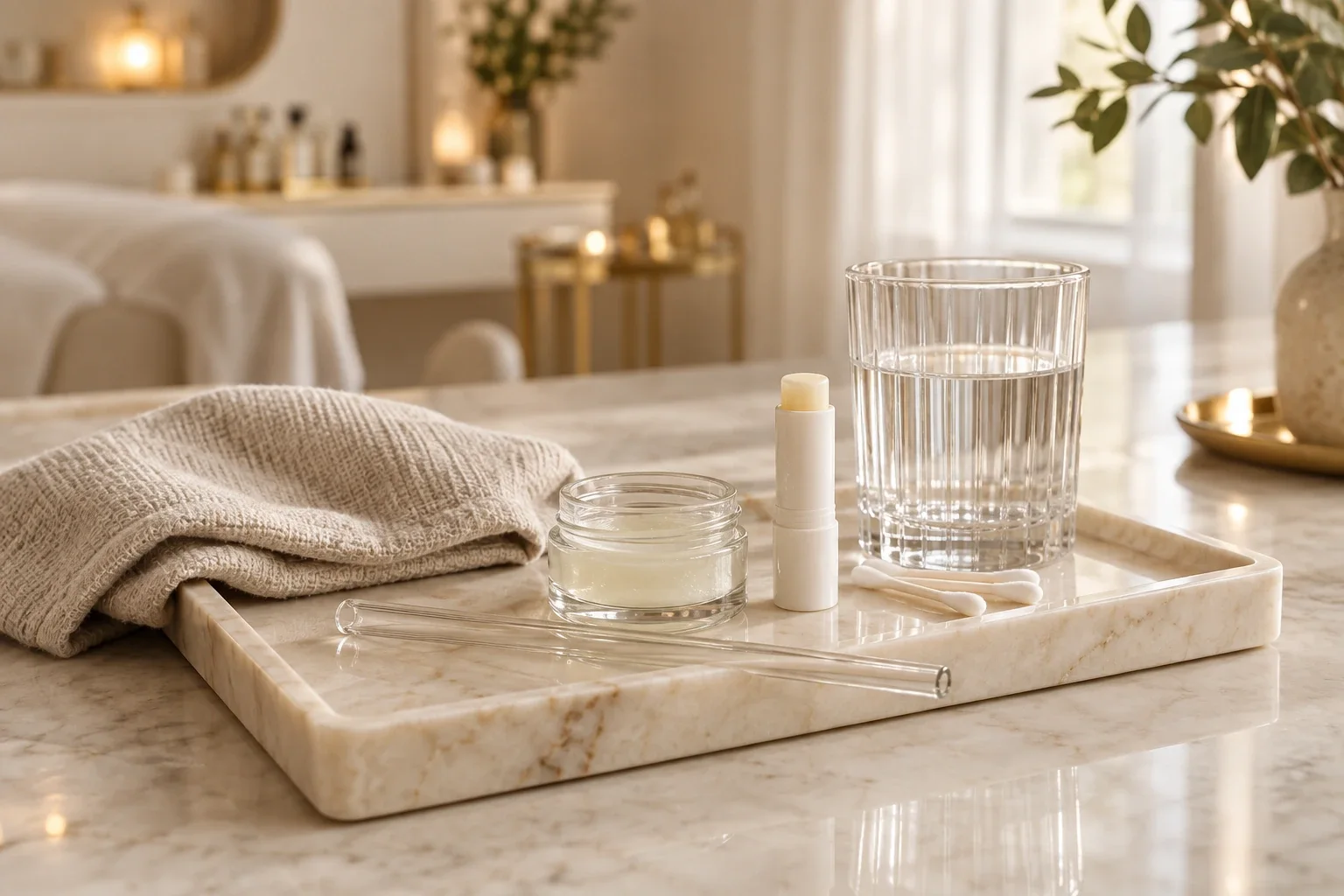
- apply the healing balm provided several times a day;
- keep your lips clean and avoid touching or picking them;
- drink through a straw for the first days and avoid spicy, salty and acidic food;
- no sauna, steam room, pool or direct sun while healing;
- no lip makeup until fully healed;
- afterwards, use an SPF lip balm to protect the colour.
Longevity, touch-ups and prices
Lip blush lasts one to three years on average, depending on your skin, lifestyle and sun exposure. The colour fades gradually and gently. To keep it vibrant, an annual touch-up between 12 and 18 months is enough to refresh it. The 6–8 week touch-up is an integral part of the protocol.
Here is the salon's current menu (full list on the service prices page):
ART
Lip blush and touch-up prices
Lips Blush Consultation Only
30 minCHF 40
Lips Blush New Set
3hCHF 500
Lips Blush Touch-up 6-8 Weeks
2hCHF 250
Lips Blush Annual Touch-up 12-18 Months
2h30CHF 350
Our main salon also presents the treatment on its own website.
Lip blush vs tinted balm, lipstick and old-style lip liner tattoos
The easiest way to see what lip blush changes is to compare it with what you already use.
| Lip blush | Tinted balm | Lipstick | Old-style lip liner tattoo | |
|---|---|---|---|---|
| Look | Sheer gradient tint across the whole lip | Light, glossy veil | Any finish, nude to bold | Hard line around the mouth |
| How long it lasts | One to three years on average | A few hours | A few hours | Long; colour can change over time |
| Day to day | Nothing to do, a balm is enough | Reapply | Reapply after meals | Nothing, but hard to adapt |
| Healing | About a week of flaking, final colour in a few weeks | None | None | — |
| Works with the others | Yes, under gloss or lipstick | Yes | Yes | Rarely flattering |
Conclusion: start with a consultation
A true lip blush "after" is judged once the touch-up has healed, never on the day of the session. In between come swelling, colour that is too bright, a week of flaking and a pale phase, all of them normal. The consultation is where you choose a shade with the final result in mind, check the treatment is right for you and plan it at the right moment. Our permanent makeup studio in Geneva would be glad to talk it through.
Your Sanctuary Awaits
Ready to Experience the Art?
“Secure your appointment today and join our community of elegant clients.”