September 28, 2026
10 min read
How Long Does Microblading Last? Longevity and Touch-Ups in Geneva

Whether you had your brows done last month or you are still weighing it up, one question always comes back: how long does microblading last before you need to go back? The short answer fits in a sentence; the useful answer needs a little more room. How long hair-stroke brows stay crisp does not depend on the artist alone. It depends on your skin, your skincare, the summer sun over Lake Geneva and, above all, on the touch-up schedule you follow. This guide stays focused on longevity: why the pigment fades, what helps it last, when to book a touch-up, and how microblading compares with the other brow techniques offered at our permanent makeup studio in Geneva.
How long does microblading last? The short version
On our microblading page we give an average of one to three years, depending on your skin type, sun exposure, aftercare and metabolism. That is a wide range, and it should be: it describes how long pigment remains visible, not how long your brows stay as sharp as they look the week after the perfecting session.
It helps to separate two ideas:
- Visibility: pigment can remain in the skin, gradually lighter, for several years.
- Crispness: the fine strokes stay precise and well coloured for a shorter period. That is what matters if you want brows that look freshly done.
This is why the salon's protocol plans an annual touch-up between 6 and 12 months, and a quarterly touch-up every 3 to 4 months for oily skin. These appointments are not a sign the technique has failed. They are part of how it is designed to work.
Why microblading fades
Microblading is manual pigmentation. The artist uses a fine blade of micro-needles to place pigment in the superficial layers of the skin, tracing tiny strokes that mimic real hairs. That shallow placement is exactly what makes the result look so natural, and also what makes it semi-permanent.
Three things explain the gradual fade:
- Skin renewal. Skin constantly renews itself, and over the months part of the pigment is naturally cleared away.
- Light. UV breaks pigment down. A summer on the lake or a ski week without protection shows on pigmented brows.
- Sebum. On oily skin, oil tends to diffuse pigment, so strokes soften and lose definition faster.
The reassuring part: good pigment fades gradually and evenly. That is the whole point of choosing the shade carefully at the consultation, based on your skin tone and hair colour, so the colour ages gracefully instead of shifting.
What shortens or extends the result
Two people treated on the same day by the same artist will not necessarily need their touch-up at the same time. The main factors are:
- Skin type. The biggest one. Normal to dry skin holds fine strokes best. Combination to oily skin, or skin with enlarged pores, holds them for less time.
- Sun. Long exposure, skiing without protection, beach holidays: all speed up fading. SPF on healed brows makes a real difference.
- Skincare. Exfoliants, acids and retinoids applied over the brows accelerate cell turnover. Keep them away from the area.
- Lifestyle. Frequent swimming, heavy-sweat training and regular sauna sessions all put the area under more stress.
- Initial healing. Picking at flakes in the first days pulls pigment out. Long-term longevity starts there.
- The 4–6 week perfecting session. Without it, some strokes never fully take and the brows fade unevenly.
Who gets the longest-lasting results?
Microblading suits most people who want to fill in or reshape their brows, and it works best on normal to dry skin, where strokes stay finest for longest.
If your skin is oily, microblading is still possible, but it comes with its maintenance: more frequent touch-ups, or a technique that combines strokes with shading. We always discuss this candidly at the consultation.
Mature skin and thinning brows
Brows often thin out with age, and microblading is a popular way to bring back structure. Mature skin can be thinner and less elastic, so the artist adapts pressure and stroke density, and sometimes suggests adding soft shading to give the brow more body. Longevity is broadly similar; what changes is the approach, which is exactly why the consultation comes first.
When to wait, or check with your doctor first
Microblading is a skin procedure, so some situations mean postponing or getting medical advice first: pregnancy and breastfeeding, unstable diabetes, blood-thinning medication, a tendency to keloid scarring, active skin conditions on the brow area, recent isotretinoin-type treatment, or ongoing chemotherapy. This is general information, not medical advice. Be open about your health and medication at the consultation; the artist may delay or decline the treatment if it is not safe for you.
Choosing a technique with longevity in mind
If how long it lasts is your main criterion, ask yourself three questions:
- What look do you want? Visible, airy hair strokes (microblading), a soft made-up powder effect (ombré), or both (combo brows or Blade & Shade)?
- What is your skin like? The oilier it is, the more shading helps retention.
- How much maintenance are you happy with? One touch-up a year, or more?
For combination to oily skin that still wants the hair-stroke effect, the Beauty Angels Blade & Shade method places strokes at the front and machine shading through the body of the brow, which improves longevity compared with microblading alone. The consultation is where that decision gets made.
The session: building a result that lasts
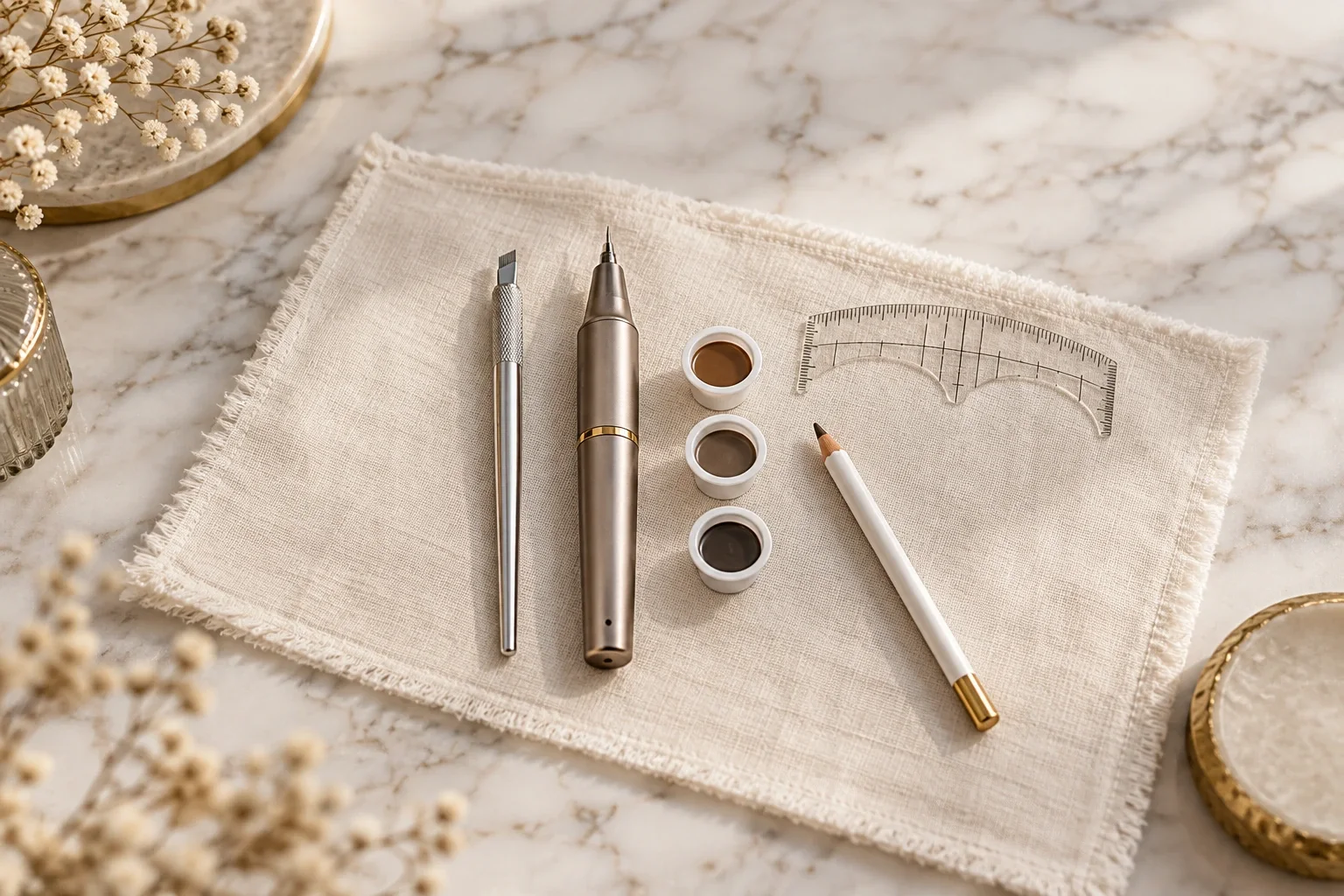
A new set of microblading takes about two hours at the salon, consultation and mapping included. Each step affects how long the result will hold.
- Consultation and patch test. We look at your skin, your brows, your expectations and your history. A pigment patch test can be carried out.
- Mapping. Measurements and the pre-drawn shape are agreed with you in the mirror. Nothing is pigmented until you approve.
- Pigment choice. The shade is matched to your skin tone and hair colour so it ages without turning.
- Strokes. After a comfort numbing cream, strokes are drawn one by one in the direction of hair growth. Depth has to be right: too shallow and the pigment leaves quickly, too deep and it can blur.
Your Sanctuary Awaits
Ready to Experience the Art?
“Secure your appointment today and join our community of elegant clients.”
Preparing for your appointment
Good preparation helps pigment settle. In the days before, avoid strong sun and sunburn on your face, and skip exfoliating products on the brow area. The day before, avoid alcohol and, if your doctor agrees, blood-thinning painkillers. Arrive without brow makeup, and mention any medication in advance.
Healing: where longevity is decided
Everyone heals at their own pace, but the table below shows the main stages, then what the following months usually look like. For a detailed day-by-day walkthrough, our main salon has a dedicated guide to the microblading healing process.
| Period | What you see | What matters for longevity |
|---|---|---|
| Days 1–2 | Brows darker and sharper than the final result, possible mild swelling | Blot gently, keep the area clean and dry |
| Days 3–10 | Colour deepens, fine flakes form and then fall | Do not pick: every flake pulled off takes pigment with it |
| Days 10–14 | "Ghost" phase: brows look very light | Normal; colour comes back afterwards |
| Weeks 3–4 | Colour settles, the real result shows | Note any lighter areas for the touch-up |
| Weeks 4–6 | Perfecting session | Essential for an even, lasting result |
| 3–4 months | First signs of fading on oily skin | Quarterly touch-up if recommended |
| 6–12 months | Softer strokes, lighter colour | Annual maintenance touch-up |
| Beyond | Pigment keeps lightening, over an average of 1–3 years | Review it at a consultation |
Aftercare that makes microblading last
We like to say half of the result depends on how you heal. In the first days:
- keep the area dry: no sauna, steam room, swimming pool or intense exercise;
- do not scratch or pick the flakes;
- apply the recommended repair cream in a thin layer;
- no makeup on the brows while they heal;
- avoid sleeping face-down for the first nights.
Long term, three habits cover most of it: sunscreen on the brows, no exfoliants or retinoids over the area, and touch-ups at the right time. These habits often decide whether you need a refresh once a year or sooner.
When to book a touch-up: schedule and prices
Microblading is always done in two steps: the new set, then the perfecting session at 4–6 weeks. A new set without its touch-up is unfinished work. After that, maintenance follows your skin.
Signs it is time
- strokes have lost their definition and look blurry;
- colour is clearly lighter, or uneven from one brow to the other;
- you are reaching for a brow pencil again in the morning;
- the shape no longer quite suits your face.
What happens during a touch-up
A touch-up is more than a quick recolour. The artist first looks at what is left: how crisp the strokes are, how even the colour is, how symmetrical the brows look. The shape is checked again, because faces change and so do preferences. Existing strokes are then retraced and, where needed, new ones added, with the pigment adjusted to how your skin held the previous one. Healing afterwards is usually gentler than after a new set, but the same aftercare rules apply, and the result is judged once it has fully settled.
If you have waited a long time
It is never "too late" to book, but the longer the gap, the closer the work gets to a new set. At the consultation the artist assesses how much pigment remains and tells you honestly whether a touch-up is enough.
Here is the salon's current menu for microblading (full list on the service prices page):
ART
Microblading and touch-up prices
Microblading Consultation Only
30 minCHF 40
Microblading New Set
2hCHF 300
Microblading Touch-up 4-6 Weeks
1h30CHF 150
Microblading Annual Touch-up 6-12 Months
2hCHF 200
Microblading Quarterly Touch-up 3-4 Months (Oily Skin)
1h30CHF 180
You can also read how our main salon presents the treatment on its microblading service page.
Microblading vs combo, Blade & Shade and ombré: longevity compared
Each technique has its own maintenance rhythm. The table follows the touch-up schedule the salon plans for each one.
| Microblading | Combo brows | Blade & Shade | Ombré powder brows | |
|---|---|---|---|---|
| Look | Hair strokes, most natural | Strokes at the front, ombré behind | Strokes at the front, machine shading | Soft made-up powder effect |
| Best skin type | Normal to dry | Normal to combination | Combination to oily | All types, including oily |
| First touch-up | 4–6 weeks | 4–6 weeks | 4–6 weeks | 4–6 weeks |
| Planned maintenance | Annual (6–12 months), quarterly for oily skin | Annual (12–18 months) | Annual (6–15 months) | Annual (12–18 months) |
| Retention on oily skin | Shorter | Better | Better | Most consistent |
If you want appointments spaced as far apart as possible, shading is your friend. If the illusion of real hairs is what matters most, microblading remains the reference, with maintenance you plan for.
Conclusion: start with a consultation
Microblading lasts one to three years on average, but its crispness is protected by careful healing, sun protection and touch-ups at the right rhythm. The surest way to know how long it will last on you is to talk it through with the artist, who will look at your skin, your brows and your lifestyle before suggesting the right technique and schedule.
Our permanent makeup studio in Geneva welcomes you for a consultation, a new set or your touch-up.
Your Sanctuary Awaits
Ready to Experience the Art?
“Secure your appointment today and join our community of elegant clients.”